
The public record, on one sheet.
A color rating, a plain-English summary and the public records behind it, with what we’d do next in your shoes.

The name on record for this number is the one he gave. A second line and one open civil case are worth a slower pace.
Save it to a card in The Vault and add what you notice yourself. Every report is kept for 12 months, and checking the same number again opens it free.
How a 9ONE0 Check works
Answer a few questions
Dating someone, or meeting someone once? Your answers set 9ONE0 up for you.
Enter their number
Start from the number you were given. You can’t look someone up by name, email or address. If a number has been shared, you pick the right person by name.
Read the report
If you keep seeing them, save it to The Vault. Every report is kept for 12 months, and checking the same number again opens it free.

Six sections, all public record.
Two sources: a licensed public records provider, and CourtListener for federal court cases.

Phone details
Carrier, line type, whether it’s a VoIP number, and whether the line is still connected.
Identity
The name, age, any other names and the email addresses on the record.
Address history
Known addresses with dates and county, and the property record behind the current one.
Marital & relationships
Whether a spouse is on record, known relatives and close associates.
Professional profile
Employer and title where the record has them, professional licenses and registered businesses.
Public record flags
Sex offender registry, criminal records, federal lawsuits and evictions.
Just ask. They choose what you see.
Always shared
Sex offender registry, criminal records, evictions and federal lawsuits, shown as summaries like “No records found”, with the name on record, the number checked and whether that identity matches the number.
Their choice
- Homeowner
- Exact address
- Licenses
- Workplace
- City
- Date of birth
Never shared
- Relatives
- Associates
Invite the person you’re meeting to run a safety check on themselves. They see their results first, then share a Trust Card with exactly what they choose.
Send a private link
Enter their number and 9ONE0 makes a link tied to it. You send it from your own phone; 9ONE0 never texts anyone, and the link stays open for 7 days.
They check, privately
They run the check on themselves and see every result first, in private. Their $25 is a hold, charged only if their records match their number.
Read their Trust Card
They share what they’re comfortable with, for 90 days and with up to 10 people. Then you answer: Yes, let’s meet, or Not this time.
Asking is free with a free account. The person checked pays $25, and only if their records match their number.
Your private dating journal, for everyone you date.
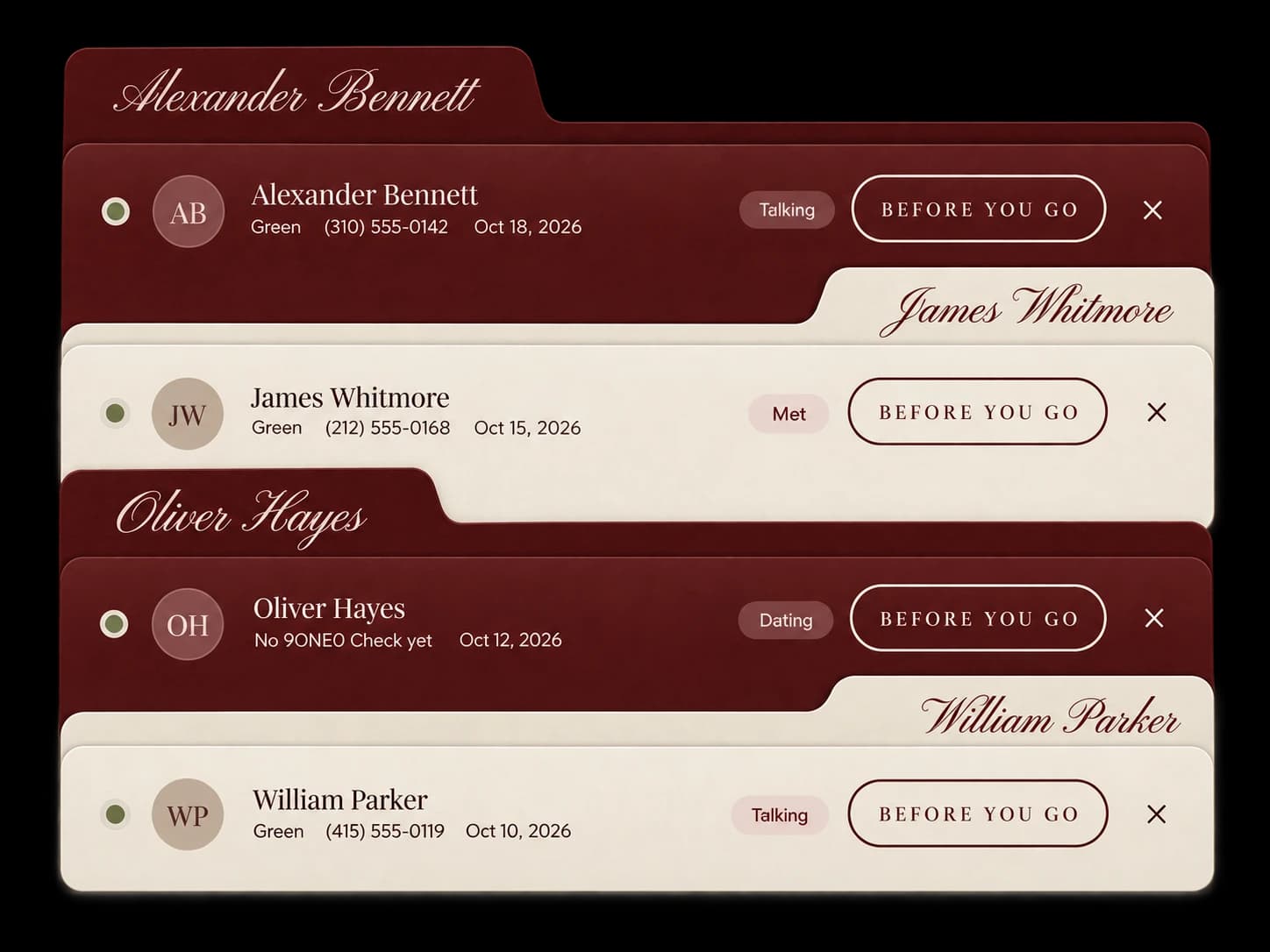
Free, with no card needed. Every person you date gets a folder: your notes, their 9ONE0 Check, and help one tap away.
Your timeline. Log each date in a few taps: before, during and after. What they said, how it felt, what you noticed.
Green flags, red flags. Choose what matters to you once. Tap flags during a date, and 9ONE0 shows you the patterns across people.
Your patterns, read by AI. Turn it on in Settings and AI sums up what keeps coming up across your dates, in plain words. It reads only your counts and the flags you tapped, never your notes.
9ONE0 Wrapped. Your year in review: how many people you met, how their 9ONE0 Checks came out, and where each one ended up.
Quick exit: one tap takes you to a different website if someone walks up.
One tap, and someone knows who you’re with.
Add one person you trust. On a date, open Get help now from the menu, or tap I feel unsafe in your check-in. Call 911 is at the top. Then one tap calls your safety contact, or texts them who you’re with: name, number, age and where you are, with a map link to your location if you add it.
The text opens in your own messages. Nothing sends until you press send.

Your notes are encrypted before they’re saved.
Every account has its own encryption key. Your notes, saved reports and safety contact are sealed under it with AES-256.
Free, no card needed. 9ONE0 never texts anyone for you.

I grew up in a family of detectives.
My father, both of my grandfathers and my uncle all investigated serious crimes. We looked things up before we trusted the story.
That instinct stayed with me. I’ve always been a deeply curious person. When I have a question, I research thoroughly, connect the details and verify the facts.
Over the years, I put that skill to work helping my girlfriends make more informed decisions before dates. I built 9ONE0 to give more women that same clarity.
Kaori TempelFounder
What we never do
We never ask for your ID.
No ID upload, no selfie, no face scan. You sign in with your email address.
We never post about anyone.
9ONE0 has no feed, reviews or public profiles. Nothing you write is shown to anyone else.
We never tell them you checked.
The person you look up is not notified.
We never sell your information.
We don’t use it for advertising or profiling, and our pages carry no advertising pixels or third-party tracking.
We never store your notes in plain text.
In a copy of our database, your notes would show only as encrypted text. The master key is never stored with the data.
What women ask before they meet.
Can’t find yours? More answers in Help
How do I check someone before a first date?
Run a 9ONE0 Check on the phone number they gave you. You’ll see public records possibly associated with that number, starting with the name on record for it, and if several people are linked to it, you pick the one you mean. Read it before you meet, trust your instincts, and meet somewhere public.
What does a 9ONE0 Check show?
A 9ONE0 Check shows public records possibly associated with the number: the name on record for it, age, past addresses, relatives, and whether a spouse is listed. It also looks for criminal records and sex offender registry listings, federal court cases and evictions, and tells you if the number is an internet (VoIP) line. Public records can be incomplete or out of date, so look any record up yourself before you act on it.
Will the person know I looked them up?
No. 9ONE0 never contacts them, and nothing is sent to them. Your 9ONE0 Checks are visible only to you, and to us only when we look into misuse.
Can 9ONE0 tell me if someone is married?
Not for certain. A report shows when the record lists a spouse, which means they are possibly married or were married before. It can’t tell you whether a marriage is current, and no spouse listed doesn’t mean they’re single, because public records can be incomplete.
Can I look someone up by name?
No. A 9ONE0 Check starts only from a phone number you already have, because a search by name, email or address would let someone find a person whose number they were never given. From a report you ran, you can also tap a relative on the record to check them.
What is a 9ONE0 Check built from?
Public and licensed records, for your own personal safety when you’re meeting someone new. 9ONE0 is not a consumer reporting agency under the FCRA, and a 9ONE0 report is not a consumer report, so it can’t be used for decisions about jobs, housing, credit or insurance.
Is 9ONE0 available in every state?
You can use 9ONE0 from any state. What differs is whom a report can be about. Reports are not available about people who live in California, Oregon, Vermont, New Jersey and Texas. Reports about people who live in California will be available starting January 1, 2027. Reports about people who live in Connecticut are not available from December 31, 2026. When a report isn’t available, your check is not used.

A 9ONE0 Check, when you need one.
Every plan includes your private Vault. Pay once, or keep lookups ready.
- Single Lookup$25Choose Single Lookup
One lookup. No subscription.
- 3 Months$33/mo
Billed $99 every 3 months.
$16.50 per lookup.
Saves you $18 against Monthly.
Start 3 Months - Monthly$39/moChoose Monthly
2 lookups a month.
Memberships renew until you cancel, from your account, in one tap. Unused lookups expire with the term. A Single Lookup never expires.
Reports are not available about people who live in California, Oregon, Vermont, New Jersey and Texas. Reports about people who live in California will be available starting January 1, 2027.